
You can start selling online without building anything. Promote a product that already exists, and put your effort into the part most product creators neglect: reaching the right people and explaining the offer clearly.
Why this is a legitimate starting point: Building a product takes months and carries a risk that nobody wants it. CB Insights’ analysis of startup post-mortems found “no market need” was the most commonly cited reason startups failed. When you promote an existing product, that research has been done by the seller. Your job is to find the people who have the need.
What you skip: Development, hosting, payment processing, updates and customer support all sit with the product owner. You never touch inventory or fulfilment. That leaves your time free for the two things that decide whether you earn anything: understanding buyers and getting in front of them.
What you can’t skip: The audience. A link with no readers behind it produces nothing, and a large but unrelated audience is almost as bad. Before you commit to a product, ask who will read your material and why they’d care.
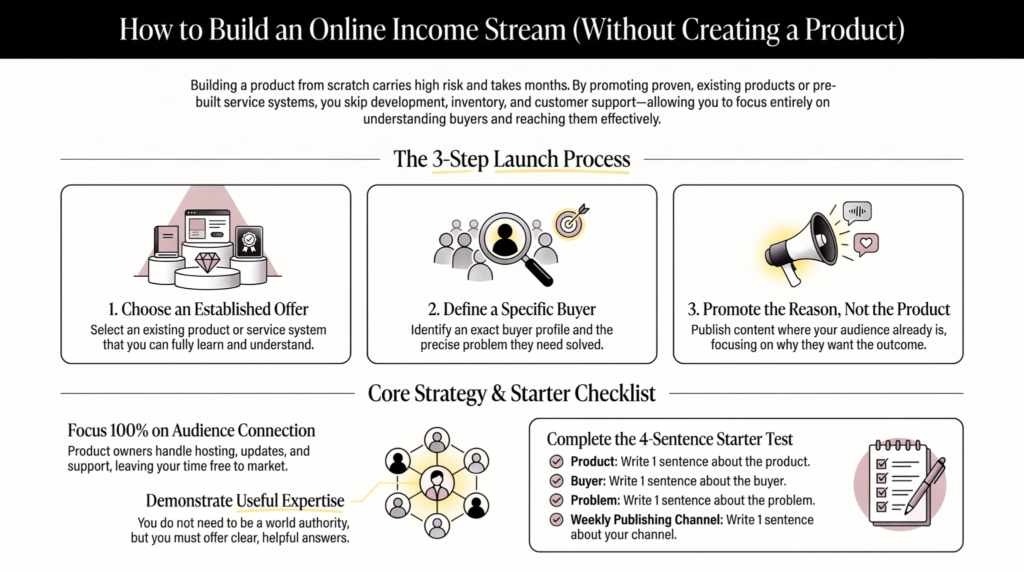
How to start, in order:
1. Choose a product you can learn fully. Read everything the seller gives you. Use it if you can.
2. Define the buyer. Not “small business owners”. Someone specific: a virtual assistant who wants to offer a new service, a freelancer who needs a repeatable outreach process, an affiliate who has traffic and no email list.
3. Write for that person. Explain the problem they have, what solving it looks like and where the product fits.
4. Publish where they already are. A LinkedIn post, a blog article, a video, a group discussion.
5. Track and adjust. Note which piece produced clicks and sales. Make more like it.
The trap to avoid: Beginners often treat “no product of my own” as “no expertise required”. The audience can tell. If you can’t answer a basic question about what you’re promoting, trust evaporates fast, and Google’s guidance on helpful content stresses first-hand experience and people-first writing for a reason. You don’t need to be a world authority. You need to be useful on the narrow topic you cover.
What it costs: Mostly time. There may be small costs for a domain, an email tool or design software, but you can begin with free channels. Be wary of anyone who says you need to buy a large package before you earn. A Sales Partner role shouldn’t ask for that.
A realistic frame: You are building a small marketing operation. Some weeks it will feel slow. The advantage is that every piece of useful content you publish stays available to be found, and the product you promote already works. You’re not betting on an unproven idea, only on your ability to connect it with the right people.
A starter checklist: Before you publish anything, write down the product in one sentence, the buyer in one sentence and the problem in one sentence. Add one channel and one weekly publishing slot. If you can’t complete those four lines, you’re not ready to start, and that’s useful to know before you spend a month producing content for no one in particular. If you can complete them, begin with a single article and see who responds.
Start with one product, one audience and one channel. Expand once you’ve seen what responds.
Sources
1. CMO Council, “Define the need before you bleed” (summarising CB Insights’ analysis of startup post-mortems; tech-startup sample). https://cmocouncil.org/expert-views/cmo-blog/define-the-need-before-you-bleed-marketing-rigor-can-reduce-start-up-failure
2. Google Search Central, “Creating helpful, reliable, people-first content.” https://developers.google.com/search/docs/fundamentals/creating-helpful-content