
Originality is overrated. Most successful small businesses sell something people already buy, with a twist in focus, speed or service. A proven market removes your biggest risk, which is whether anyone wants the thing at all.
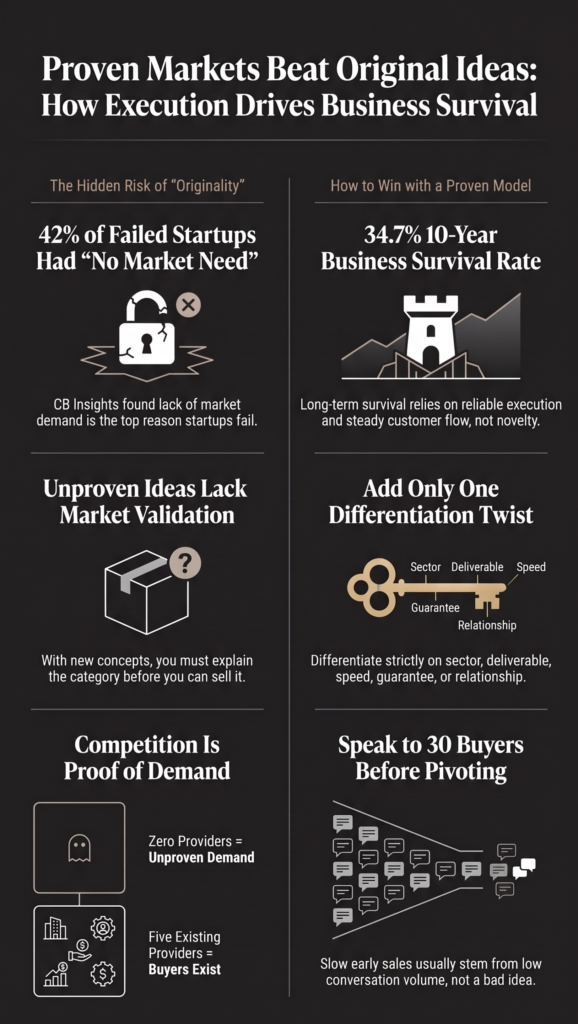
CB Insights’ study of 101 failed startups ranked “no market need” first, at 42 percent. Original ideas carry that risk by definition. Nobody has bought them yet, so you can’t know if they will. A service that businesses already pay for has passed the test. You’re competing for a share of existing demand.
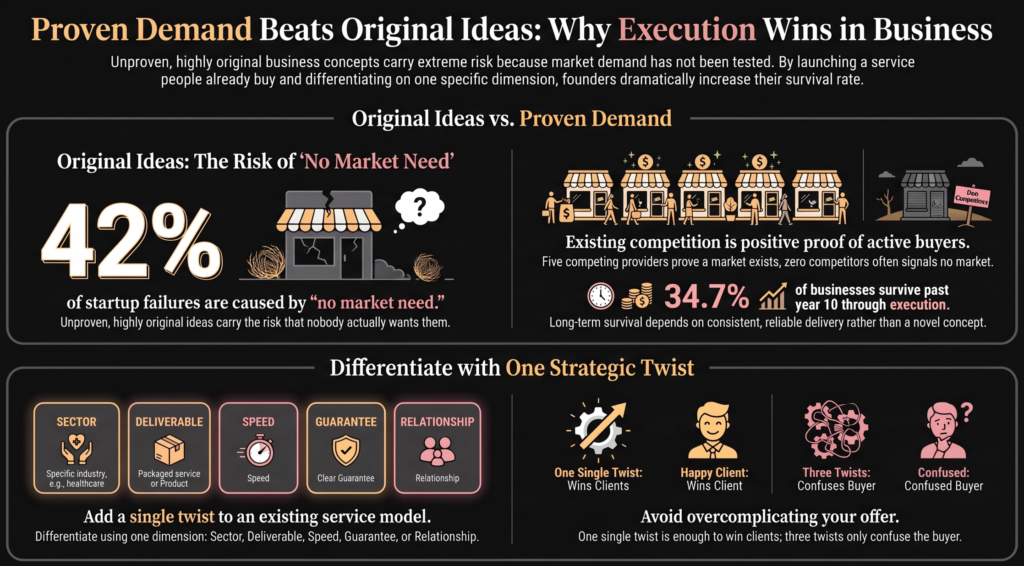
What copying well looks like. You don’t need to invent lead research, reporting or appointment setting. You need to do it well for a specific group of buyers. Differentiate on something real: a narrower niche, a clearer deliverable, a faster turnaround, a more reliable process or a friendlier relationship. Small differences in execution decide who wins repeat business.
Competition is evidence. A market with five providers tells you buyers exist and spend. A market with none tells you nothing, or tells you something worse. Treat competitors as research. Read their offers, note their prices and read their reviews. Where clients complain, you have an opening.
The numbers favour execution. The US Bureau of Labor Statistics found that 34.7 percent of establishments born in March 2013 were still operating in March 2023, with the steepest loss in year one. Businesses that survive tend to be the ones that deliver consistently and find a steady flow of customers, not the ones with the cleverest concept. Reliability does more for survival than novelty does.
Where to add your twist. Choose one dimension:
• A sector: the same service for a group nobody serves well.
• A deliverable: a clearer, more useful output than the usual.
• A speed: results in days where others take weeks.
• A guarantee: a defined standard and a fix if you miss it.
• A relationship: direct access, a named person and a monthly review.
One twist, done well, is enough. Three twists confuse the buyer.
Why originality tempts people. It feels like an escape from competition. In fact it removes the signals that tell you what to build. You can’t compare prices, can’t copy what works and can’t ask buyers to choose between options they know. You have to explain the category before you can sell in it.
A safer path. Pick a proven service. Learn it by delivering it. After a year of client work you’ll know where the gaps are. Many of the best new products and services come from practitioners who spotted an unmet need while doing the standard job. Originality earned through practice is more valuable than originality imagined in advance.
What to do this week. List three services that businesses already buy and that you can deliver. Find five providers for each. Write what you’d do differently and for whom. Pick the one where your difference is clearest and talk to ten buyers.
Beware the pivot reflex. When sales are slow, a new idea feels like progress. It rarely is. Most slow starts come from unclear targeting or too few conversations, not from the idea. Before you switch, count how many buyers you’ve spoken to. If it’s under thirty, the problem is volume, and a new idea would only reset the count.
You don’t need a new idea. You need a clear one, delivered well, to people who already know they have the problem.
Sources
1. CMO Council, “Define the need before you bleed” (summarising CB Insights’ analysis of startup post-mortems; tech-startup sample). https://cmocouncil.org/expert-views/cmo-blog/define-the-need-before-you-bleed-marketing-rigor-can-reduce-start-up-failure
2. U.S. Bureau of Labor Statistics, “34.7 percent of business establishments born in 2013 were still operating in 2023,” The Economics Daily, 2024. https://www.bls.gov/opub/ted/2024/34-7-percent-of-business-establishments-born-in-2013-were-still-operating-in-2023.htm