
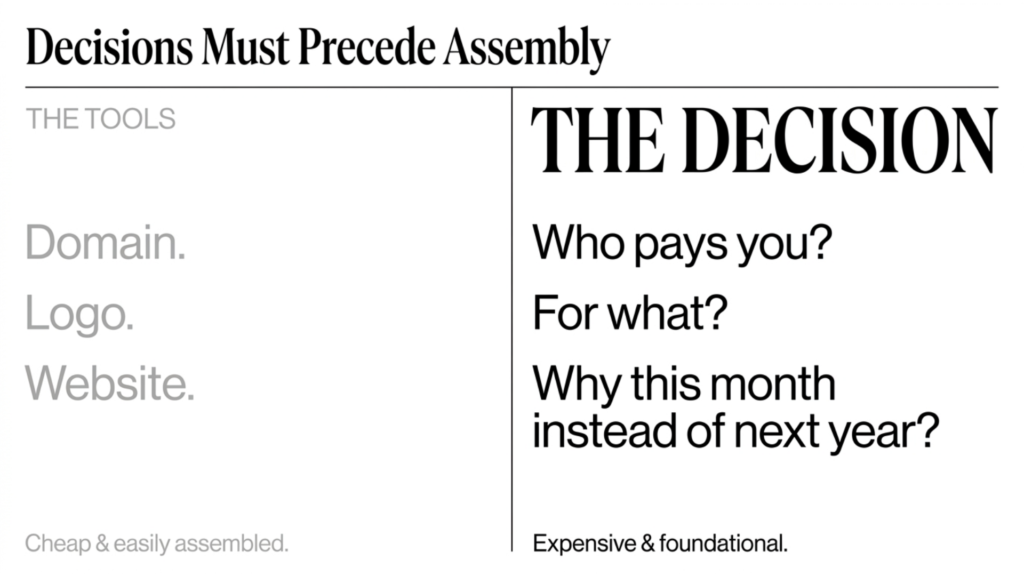
Most advice on starting an online business opens with tools: a domain, a logo, a website builder. I open with a decision, because the tools are cheap and the decision is expensive. You need to know who pays you, for what, and why they pay this month instead of next year. Everything else is assembly.
Start with the numbers that should sober you. The US Bureau of Labor Statistics followed private-sector establishments born in March 2013 and found that 34.7 percent were still operating in March 2023. The steepest loss came in year one, a fall of 20.4 percentage points. Those figures cover every kind of new establishment, restaurants and factories included, so an online service business with no premises faces different economics. The shape still transfers. The first twelve months do most of the killing, and your plan should be built to survive them.
Step one is choosing a model. Services are the fastest route to revenue because the product is your time and judgment, and you can sell before you build anything. Digital products need an audience first. Affiliate income needs traffic first. A service needs one buyer. If you have no capital and no audience, that asymmetry settles the question.
Step two is picking a customer. Choose a category of buyer you can name and find: dental practices in your state, e-commerce founders past a certain size, authors with a book already out. A sharp customer definition lets you answer two questions quickly. Where do these people gather online, and who already sells to them? If the answers are “nowhere” and “no one”, the market is either empty or hidden, and you cannot afford to find out which.
Step three is building an offer. An offer states a result, a scope, a timeframe and a fee. “Social media help” is a topic. “Twelve posts a month, scheduled and reported on, delivered by the fifth” is an offer. Buyers compare offers. They cannot compare topics.
Step four is finding the first clients, and it is where most plans die quietly. CB Insights reviewed 101 startup post-mortems and put “no market need” at the top of the list, cited by 42 percent of the failed companies, ahead of running out of cash at 29 percent. That sample is venture-style technology startups, so read the percentages as a pattern and not as a forecast for a solo service. The pattern holds anyway: people build first and confirm demand later. Reverse the order. Talk to ten potential buyers before you write a line of copy. Ask what they pay for today, who they pay, and what irritates them about it. Offer a small paid piece of work. A paid pilot teaches you more than a month of landing-page tweaks.
Step five is delivery. Your first client tests your process as much as your idea. Write down what you did, in what order, and how long each part took. That document becomes your standard procedure and your quoting tool.
The market for this kind of business is crowded with people who made the same start. The Australian Bureau of Statistics counted 2,814,778 actively trading businesses at 30 June 2026, and the number of non-employing businesses grew 4.8 percent in 2025-26. The system makes starting easy, so starting proves nothing. Repeat paid work is the achievement.
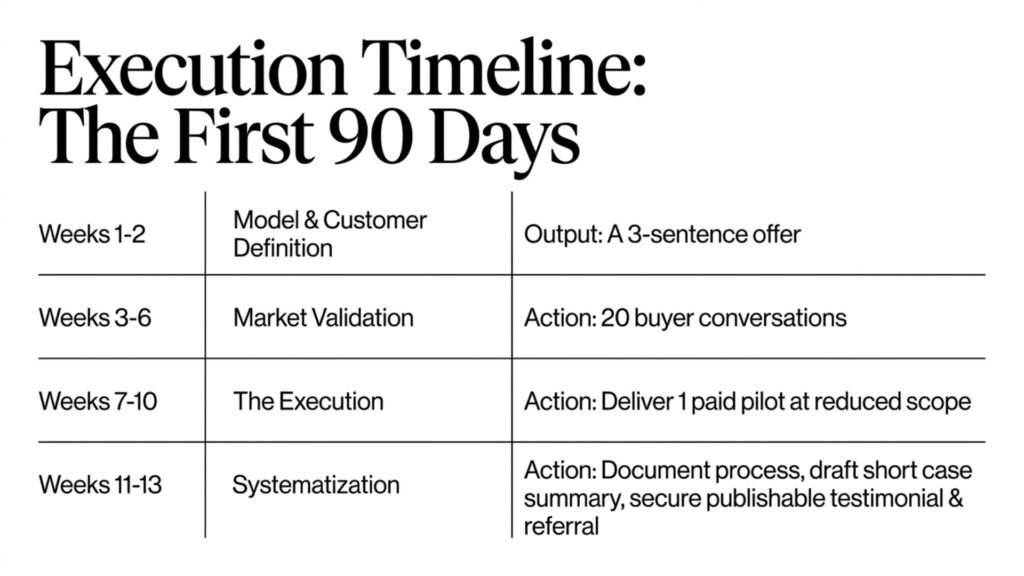
Here is the sequence I would run across your first ninety days. Weeks one and two: choose the model and the customer, and write the offer in three sentences. Weeks three to six: hold twenty conversations with people who match the customer description. Weeks seven to ten: deliver one paid pilot at reduced scope. Weeks eleven to thirteen: document the process, turn the pilot into a short case summary, and ask the client for a referral and a testimonial you have permission to publish.
Skip the logo until you have revenue. Skip the course on funnels. Skip the six-month plan. A business that can take a payment, deliver a result and earn a second order is a business, and you can build one inside a quarter.
Sources
1. U.S. Bureau of Labor Statistics, “34.7 percent of business establishments born in 2013 were still operating in 2023,” The Economics Daily, 2024. https://www.bls.gov/opub/ted/2024/34-7-percent-of-business-establishments-born-in-2013-were-still-operating-in-2023.htm
2. CMO Council, “Define the need before you bleed: marketing rigor can reduce start-up failure” (summarising CB Insights’ analysis of 101 startup post-mortems), 2021. https://cmocouncil.org/expert-views/cmo-blog/define-the-need-before-you-bleed-marketing-rigor-can-reduce-start-up-failure
3. Australian Bureau of Statistics, “Counts of Australian Businesses, including Entries and Exits,” July 2022 to June 2026 release. https://www.abs.gov.au/statistics/economy/business-indicators/counts-australian-businesses-including-entries-and-exits/jul2022-jun2026