
Accountability sells structure. People often know what they want to do and do not do it consistently. A weekly commitment, a short check-in and a record of results give them a reason to show up, and they will pay for it if it works for them and fits their budget.

The revenue model in the Accountability Coach Business Builder is a monthly subscription. Each client pays a recurring amount for tracking and a summary, and the dashboard shows monthly recurring revenue in AUD alongside active clients, average completion rate and clients at risk. Set your own after you know your costs and your clients.
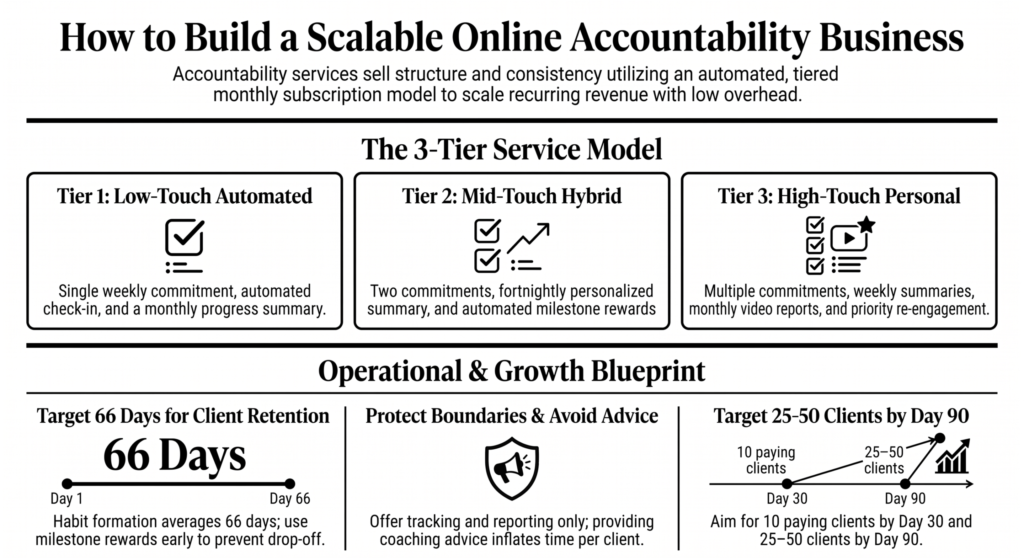
Three tiers frame the offer. The first is an automated service with one commitment, a weekly check-in and a monthly summary. The second adds a second commitment, a fortnightly personalised summary and milestone rewards. The third adds more commitments, a weekly summary, a monthly video report, milestone gifts and priority re-engagement. A tiered structure lets people choose depth. It also lets you serve many people at a low-touch level and a few at a high-touch level.
The money comes from scale and retention. A subscription service with a few dozen clients can support a modest income without heavy hours, provided the system is automated where it can be and personal where it counts. Retention matters most. A client who stays for a year is worth many times a client who leaves in month two. Harvard Business Review’s discussion of customer retention notes that keeping customers is generally less costly than acquiring new ones. The app’s business health module and dip-window analysis are built to help you see where clients leave.
Milestones support retention. Lally and colleagues found that habit formation took a median of 66 days, with wide variation between people and behaviours. The finding suggests that early weeks are fragile and that recognition at set points could help, although the study did not test accountability services. The app places rewards at streak milestones, and I would watch the data to see where your clients drop away.
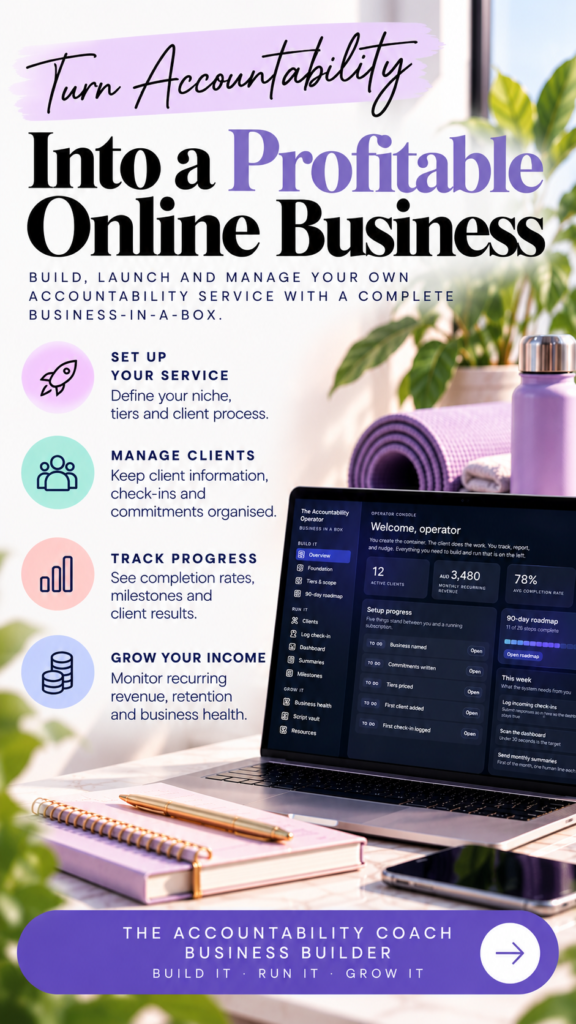
Keep costs low. The tools are a payment link for each tier, a form, a spreadsheet or tracker and email. Your main cost is time, which is why the app wants the check-in to take two minutes and the dashboard scan to take under thirty seconds.
Protect the model with scope. If clients begin asking for advice, your time per client rises and your service becomes coaching, which is a different product. The script vault gives you replies that keep the boundary without losing the client.
Be careful with claims. You can promise to track, remind and report. You cannot promise that people will reach their goals. In Australia, representations in trade or commerce must not be misleading or deceptive, and goal outcomes are not yours to guarantee.
If your annual turnover approaches AUD 75,000, GST registration becomes relevant for most businesses.
Be realistic about growth. The roadmap targets ten paying clients by day thirty after launch and twenty-five to fifty by day ninety. Treat those as aims. Many services take longer.
Plan your time as carefully as your price. Estimate the minutes each client takes per week for logging, nudging and summarising, and multiply by your target number of clients. If the total exceeds the hours you want to work, automate more of the routine or cap the number of places you offer.
Sources
1. Harvard Business Review, “The Value of Keeping the Right Customers,” 2014. https://hbr.org/2014/10/the-value-of-keeping-the-right-customers
2. British Psychological Society Research Digest, on how long habits take to form (Lally et al.; a median of 66 days with wide variation). https://bps.org.uk/research-digest/how-form-habit
3. Sprintlaw, “Section 18 of the Australian Consumer Law Explained.” https://sprintlaw.com.au/articles/section-18-of-the-australian-consumer-law-explained/
4. business.gov.au, “Register for Goods and Services Tax (GST).” https://business.gov.au/registrations/register-for-taxes/register-for-goods-and-services-tax-gst