A cold email service writes and runs outbound email campaigns for clients who want conversations with people who do not know them yet. You work out who the client should reach, shape an offer, write a short sequence, set up the sending infrastructure, manage replies and report. The skill is part research, part copywriting and a good deal of operational care.
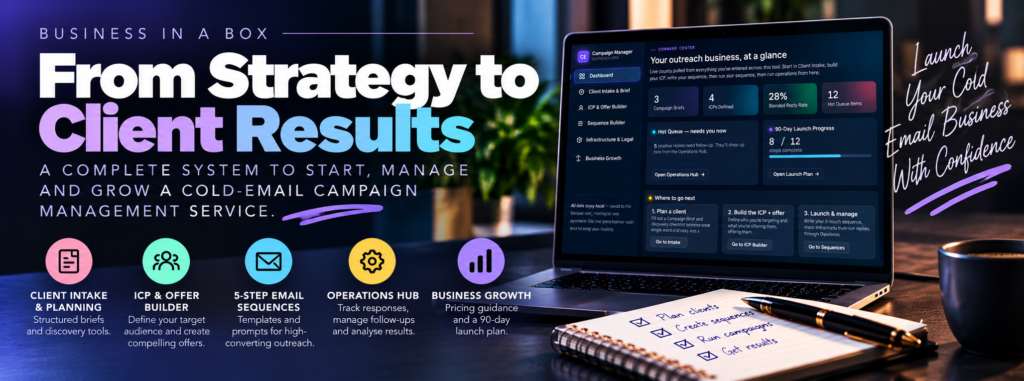
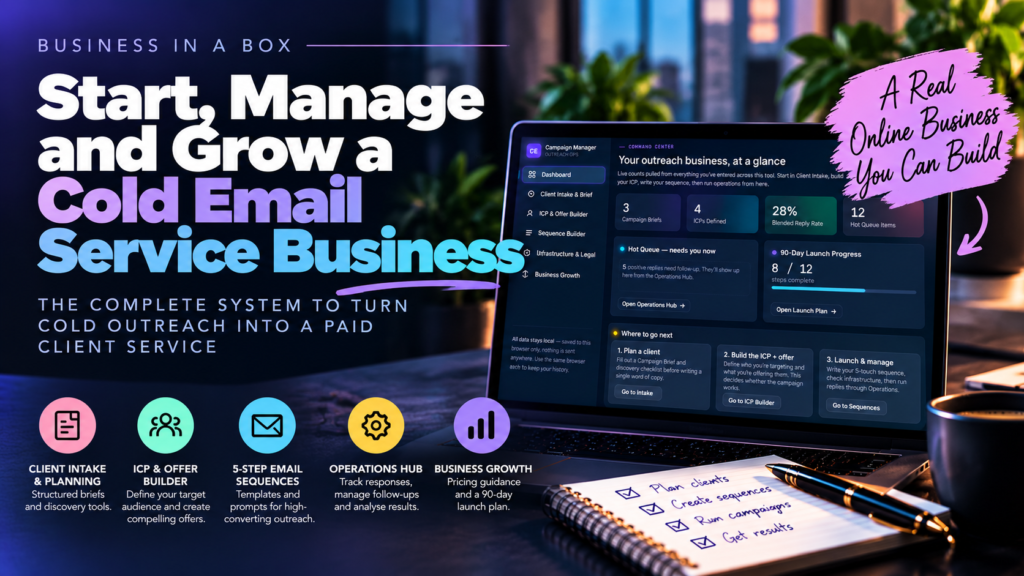
Most beginners underestimate the operational part. Copy is the visible craft. Domains, authentication, warm-up, list quality, reply handling and compliance decide whether the copy is read. The Cold Email Campaign Manager is a single-file workspace that holds those parts together. It has a dashboard called the Command Center, client intake and campaign briefs, an ICP and offer builder, a sequence builder, an infrastructure and legal module, an operations hub for records and responses, and a business growth module with a 90-day launch plan. It does not send email or find leads. It organises the work of someone who does.
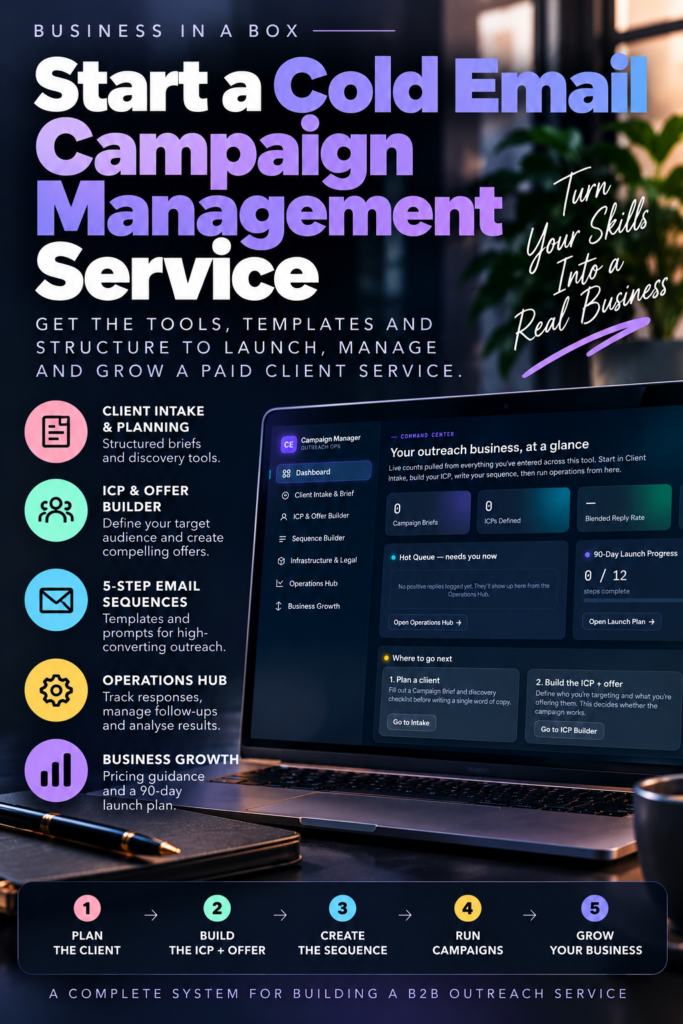
I would start with intake, because every campaign begins with a brief. The app asks for the client and campaign names, business context in plain language, goal definition such as booked calls per month and target reply rate, a prior outreach audit, the competitive landscape, and timeline and constraints including launch date, sending limits and compliance. The brief is described as your north star: it removes ambiguity and gives you something to point to if a client wants to change direction mid-campaign. A discovery call checklist sits beside it, with questions on win rate and objections.
Then the ICP and offer. The app suggests running two or three ideal customer profiles per campaign, split into a primary profile with about 60 per cent of volume, an adjacency with 30 per cent and a wildcard with 10. It offers four offer types: an audit, an insight, a case study and a direct ask. It follows with an anatomy checklist for a strong offer and a validation checklist to test before launch. Good copy cannot rescue a weak offer, and the tool places that decision before the writing.
The sequence builder holds five-touch sequences with a subject line tester and personalisation tiers. Infrastructure comes next, with sending domains, DNS requirements and a six-week mailbox warm-up tracker. Operations cover weekly campaign records and a response board.
Deliverability is a matter of rules as well as technique. Google and Yahoo expect bulk senders to authenticate their mail with SPF, DKIM and DMARC, offer one-click unsubscribe on marketing messages and keep spam complaint rates under 0.3 per cent. The thresholds apply to those sending thousands of messages a day to personal accounts, but the habits are good practice at any volume.
Data stays in your browser’s local storage and nothing is sent anywhere. Export backups, since client briefs and sequences are the value in the app.
If you can write short, respectful emails and keep orderly records, the service is viable. The console supplies a frame so you can do it for several clients without mixing them up.
Run a rehearsal before anything goes live. Fill in a brief for an imaginary client, build two ICPs, write one offer and draft the five emails. Time each step. That one afternoon tells you whether you enjoy the work and where your process is thin, and the notes you take become the first draft of your own playbook.
Sources
1. Close Help Centre, “Requirements for bulk email senders” (summarising Google and Yahoo sender rules). https://help.close.com/technical-support/email-deliverability/requirements-for-bulk-email-senders