
Every business needs customers, and most owners are bad at the mechanical parts of getting them: building lists, writing messages, following up, booking meetings, reporting results. That gap is your market. The ecosystem has five layers. Knowing which one you serve prevents the commonest mistake, selling “lead generation” as a single fuzzy service.
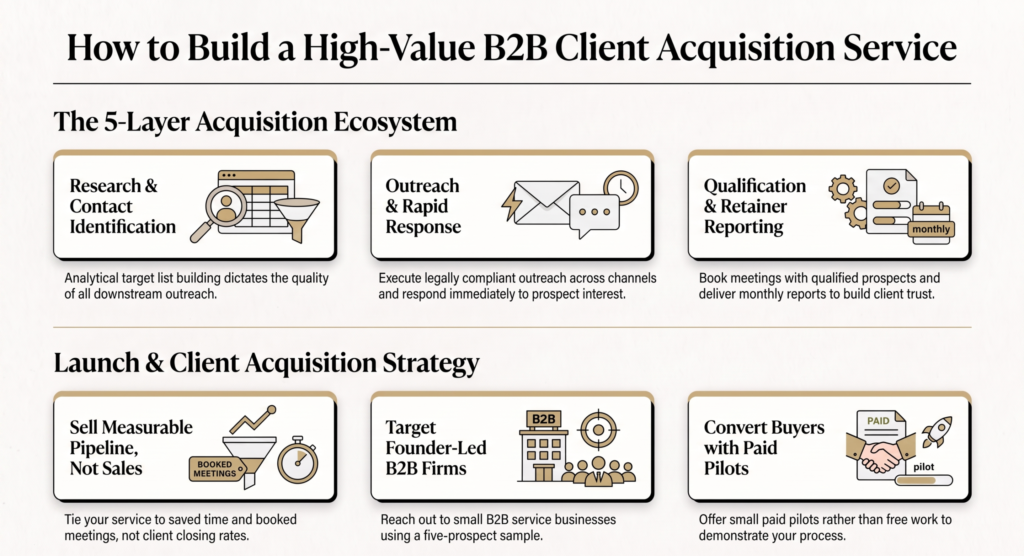
Layer one: research. Someone defines the ideal customer and identifies companies and contacts that fit. This work is analytical and quiet, and it decides the quality of everything downstream.
Layer two: outreach. Someone contacts those prospects by email, LinkedIn, phone or warm introduction. This layer faces the most regulation. In Australia, the Spam Act requires consent, sender identification and a working unsubscribe in commercial electronic messages. In the US, the CAN-SPAM Act applies to business email too and requires opt-outs to be honoured within ten business days.
Layer three: conversation handling. Someone replies to interest, answers questions and moves the prospect toward a meeting. Speed matters here. A Harvard Business Review study of online sales leads, covering 1.25 million leads across 29 B2C and 13 B2B companies, found that most firms responded far too slowly and that leads go cold quickly.
Layer four: appointment setting. Someone turns interest into a confirmed meeting on a salesperson’s calendar. The skill is qualification: knowing which replies deserve the salesperson’s time.
Layer five: reporting. Someone shows the client what was done and what came of it. Reports build trust and justify the retainer.
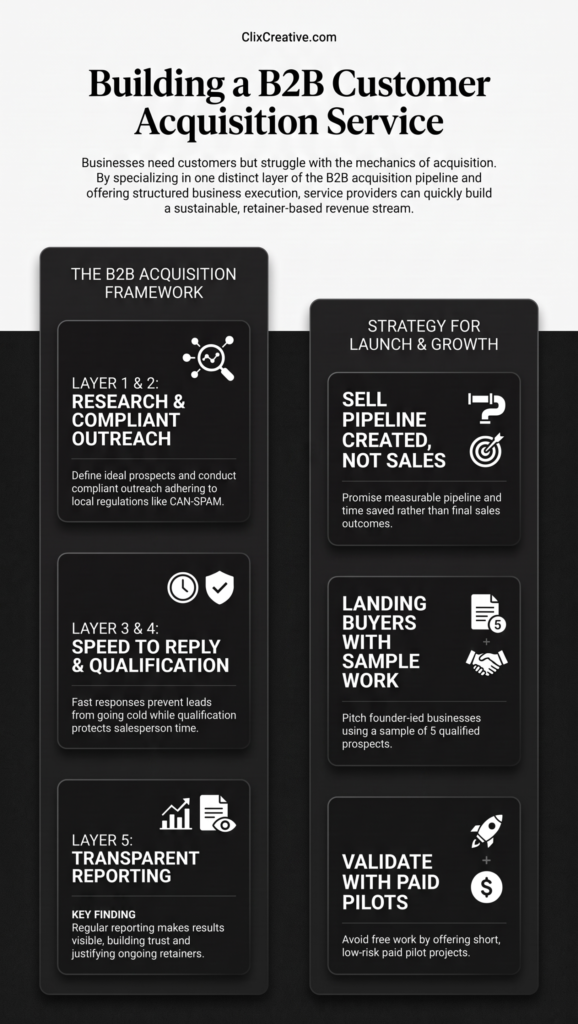
Where do you fit? Pick one layer to start. Research is the easiest to learn and the safest legally. Outreach pays well and carries the most risk. Appointment setting suits people who are quick, polite and organised. Reporting works as an add-on to any of the others.
What you’re selling. You sell time saved and pipeline created. Buyers judge you by what appears in their diary and their pipeline, so tie your offer to something measurable you can influence: qualified prospects delivered, replies handled within a set time, meetings booked. Don’t promise sales. You don’t control the client’s closing ability, pricing or follow-up, and a promise you can’t keep ends the relationship.
How to find the first buyer. Look for companies that sell high-value services to other businesses and have a small sales team: consultancies, software firms, agencies, equipment suppliers. A founder-led company that doesn’t have time to prospect is ideal. Send a two-line message with a short sample of your work, such as five qualified prospects with a line on why each fits. Ask if they’d like the other ninety-five.
How to keep them. Report monthly. Say what you did, what happened and what you recommend next. Clients stay with a provider who makes the results visible.
What to expect in the first month. Expect slow replies, polite refusals and at least one prospect who asks for the work free. Say no to free work and yes to a small paid pilot. A pilot of 25 prospects or one week of follow-up shows your method and costs the client little. By the end of month one you should know if a segment responds. If it doesn’t, change the segment before you change your service.
The business of helping other businesses get customers is crowded at the top and thin at the specialised end. Pick a layer, pick an industry and be the person who does that one thing well.
Sources
1. Australian Communications and Media Authority, “Avoid sending spam.” https://acma.gov.au/node/73
2. U.S. Federal Trade Commission, “CAN-SPAM Act: A Compliance Guide for Business.” https://www.ftc.gov/business-guidance/resources/can-spam-act-compliance-guide-business
3. James B. Oldroyd, Kristina McElheran and David Elkington, “The Short Life of Online Sales Leads,” Harvard Business Review, 2011. https://scholarsarchive.byu.edu/facpub/9711