
The two get confused, and the confusion costs providers clients and sometimes trouble. Life coaching is broad and open-ended. Accountability coaching is narrow and operational. Knowing the difference lets you describe your service accurately and stay inside it.
Life coaching works on the whole person. A life coach helps clients explore values, priorities, relationships and direction. The questions are large: what do you want from your life, what holds you back, what would fulfilment look like. Sessions are conversational, and the outcome is clarity, which is hard to measure.
Accountability coaching works on commitments. The client already knows what they want to do. The coach helps them set clear actions, track them and report on them. The questions are small: what will you do this week, when, how will we know, what got in the way. The outcome is follow-through, and it’s measurable.
Focus. Life coaching asks “what?” and “why?” Accountability coaching asks “did you?” and “what next?” One explores. The other executes.
Structure. Life coaching sessions are often flexible and led by the client’s concerns. Accountability coaching follows a defined structure: goal, weekly commitments, check-in, tracker, review. The structure is part of what the client pays for.
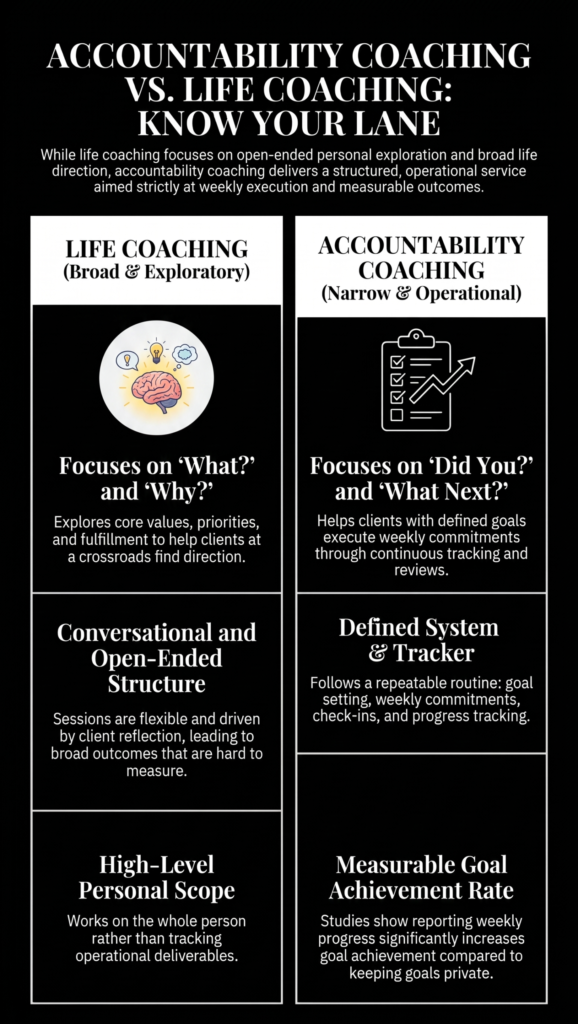
Measurement. An accountability coach can show a record: actions committed, actions completed, patterns across weeks. A life coach’s results are harder to show and usually depend on the client’s reflection.
Boundaries. Accountability coaching has narrower boundaries. It doesn’t explore emotional history, diagnose problems or give personal advice. If clients raise matters outside the scope, the coach acknowledges them and suggests suitable support. That clarity is a strength in the market, because buyers know what they get.
Who benefits. Life coaching suits people at a crossroads or seeking direction. Accountability coaching suits people with clear goals who need consistency. A freelancer who wants to send ten proposals a week doesn’t need an exploration of purpose. They need someone to ask on Friday whether the proposals went out.
What the research says. Matthews’ study reported that participants who sent weekly progress reports to a friend were more likely to report achieving their goals, with over 70 percent against 35 percent for those who kept goals private. The results were self-reported, and the summary lacks detail on design, so treat the finding as supportive evidence and not proof. For an accountability business, it supports the claim that reporting to someone helps.
How to describe yourself. “I help freelancers and founders follow through on the weekly actions they’ve committed to. I run check-ins, track progress and provide a monthly review.” That sentence says what you do and implies what you don’t.
Keep your claims accurate. Australian Consumer Law prohibits misleading or deceptive conduct. Don’t imply that you provide counselling, therapy or guaranteed outcomes.
Handle the overlap openly with clients. Some clients want both: direction and follow-through. You can work with them by agreeing their goal first, from their own plan, and then running the accountability. If they need help deciding what to do with their life, refer them to a coach or counsellor who offers that, and return to the structure when the direction is set.
Pick the lane that matches your skills. If you like structure, tracking and routine, accountability coaching is a cleaner product to sell.
Sources
1. Dominican University of California, Gail Matthews, goals research summary (self-reported results; limited published detail). https://www.dominican.edu/sites/default/files/2020-02/gailmatthews-harvard-goals-researchsummary.pdf
2. Sprintlaw, “Section 18 of the Australian Consumer Law Explained.” https://sprintlaw.com.au/articles/section-18-of-the-australian-consumer-law-explained/