A podcast booking business sells one thing: appearances on other people’s shows for clients who have something worth saying. You research shows, position the client, pitch the host, follow up, handle the logistics, and report what happened. The skill is a mix of research, writing and persistence. The overhead is a laptop and an inbox.
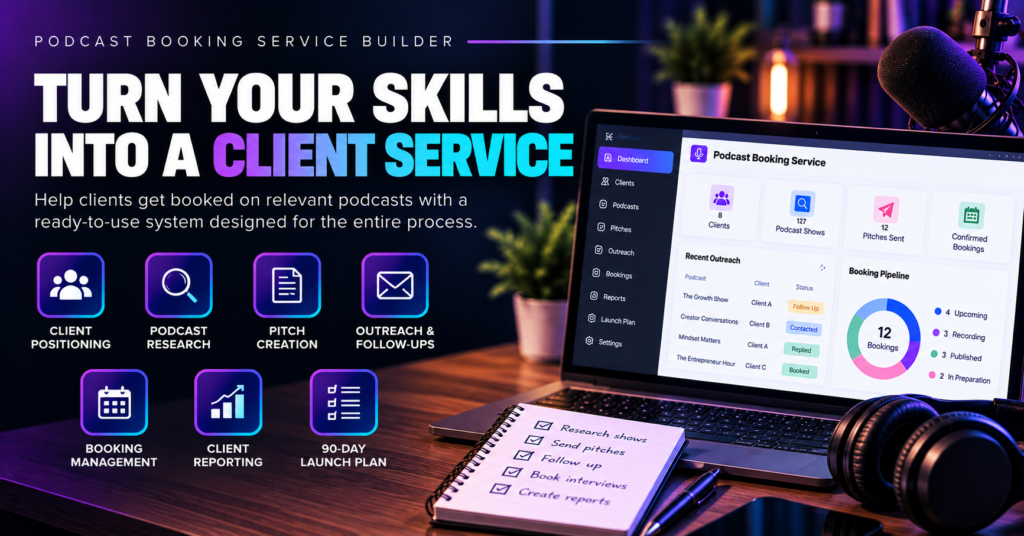
Most people who try this get stuck on the plumbing. They can write a decent email and still lose track of which host replied, which show was pitched twice, which client has an episode going live next week. The Podcast Booking Service Builder is a single-file console that holds that plumbing: client positioning, a show database, a pitch writer, a pipeline, follow-up sequencing, booking logistics, reporting and a 90-day launch plan. It does not send email or find shows for you. It keeps the operation orderly while you do the work.
I would start with positioning, which is the first module for a reason. Before you pitch a single host, each client gets an intake call built on four parts: their story, their angle, their results and the benefit to a listener. From that you write a one-page positioning document with an authority statement, talking points and episode titles. The console gives you a form for each, including a formula for the authority statement (subject, outcome, mechanism and an unexpected angle), a two-sentence third-person bio and at least five distinct episode angles from different entry points. The sequence matters because a pitch is only as strong as the idea inside it.
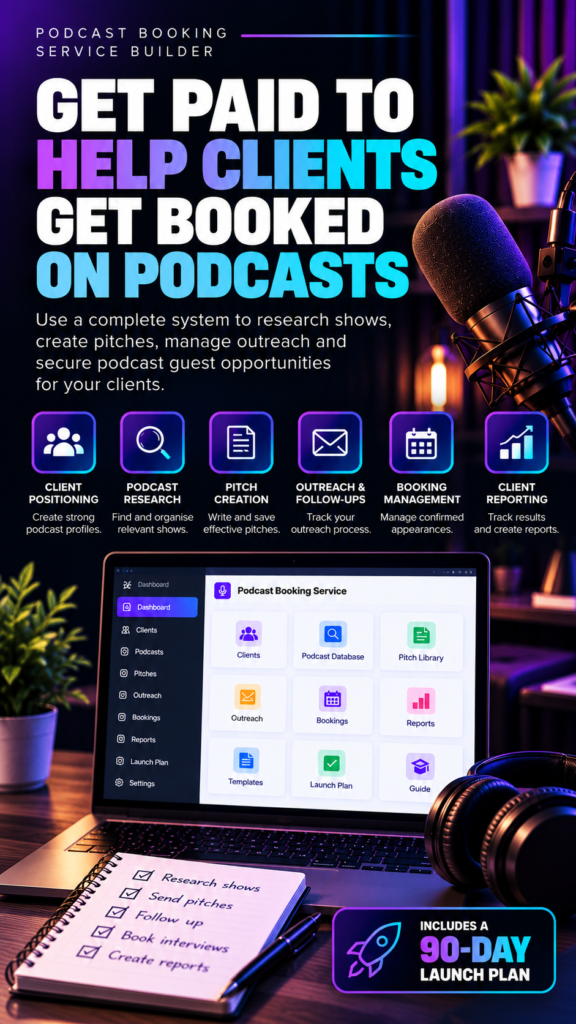
Then comes the show database. Every show gets a record with host, category, tier, release frequency, contact email, assigned client, status, last contact date and notes, plus a qualification checklist the show must clear before it enters your active pitch queue. The launch plan suggests researching a hundred shows before you pitch fifty, and I think that ratio is right. Pitching from a thin list produces weak matches and a lot of wasted goodwill.
The pitch writer helps you assemble messages from fields: client, host first name, show name, a specific episode you are referencing, the episode angle, a contrarian claim, talking points framed as listener benefit and a proposed timeframe. It offers two customisation levels.
The audience is real. The 2026 Infinite Dial Australia survey of 1,600 people aged ten and over found 50% had listened to an audio podcast in the past month and 45% weekly. A market that size is why hosts are flooded with requests, and why a pitch that shows you listened stands out.
Everything you enter stays in your browser’s local storage. Nothing is uploaded, which suits client positioning documents and contact details. Back it up regularly, since clearing site data deletes it.
If you are organised, write well and can stay polite through silence, this is a workable service business. The console will not supply the writing. It supplies the structure that lets you do it for several clients at once without losing the thread.
Set a modest first goal: one client, one niche, fifty pitches and a report. That small loop teaches you the whole business, and the console’s launch plan is written to take you around it. Once the loop works, widen it. Until it does, adding features or clients only multiplies the problems.
Sources
1. Mediaweek, “Infinite Dial Australia 2026” (Edison Research survey of 1,600 Australians aged 10+, April 2026). https://www.mediaweek.com.au/radio/infinite-dial-australia-2026-radio-podcasting-milestone