A B2B side hustle sells to companies. That means larger invoices, fewer customers and a buyer who thinks in terms of return. The ten below can be delivered remotely, started with little money and run around another commitment. For each, I’ve noted what the buyer pays for.
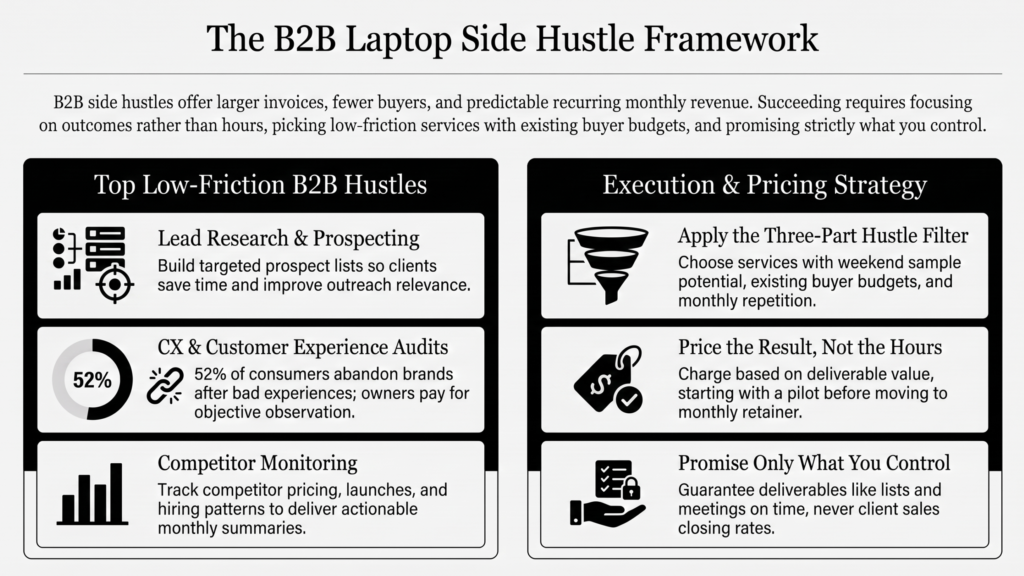
1. Lead research. You build qualified prospect lists for companies that sell to other businesses. The buyer pays for saved time and relevance.
2. Competitor monitoring. You track pricing, product launches and hiring patterns in a client’s market and report monthly. The buyer pays for awareness they lack the time to maintain.
3. LinkedIn outreach management. You run connection and messaging campaigns for service providers. The buyer pays for conversations with the right people. Read LinkedIn’s rules first: its help centre prohibits third-party software that automates activity on its platform.
4. Cold email management. You handle list preparation, copy, sending and follow-up. The US CAN-SPAM Act applies to business email with no exception, and Australia’s Spam Act requires consent before commercial messages.
5. Podcast booking. You find suitable shows for authors, consultants and founders, pitch them and manage the calendar. The buyer pays for access to audiences.
6. Appointment setting. You handle replies from outreach and book qualified meetings. The buyer pays for a full diary.
7. Mystery shopping and customer-experience audits. You test how a business treats customers and report the gaps. The buyer pays for objective observation. A 2025 PwC survey found 52 percent of consumers had stopped buying from a brand after a bad experience with its products or services, and 29 percent after poor customer experience specifically. Owners have a reason to measure.
8. Monthly reporting. You turn a client’s scattered numbers into a one-page summary with comments and next actions. The buyer pays for clarity.
9. Client onboarding setup. You build intake forms, contracts and kickoff sequences. The buyer pays for a professional first impression and fewer back-and-forth emails.
10. Accountability support. You run structured check-ins for professionals pursuing defined goals. The buyer pays for follow-through.
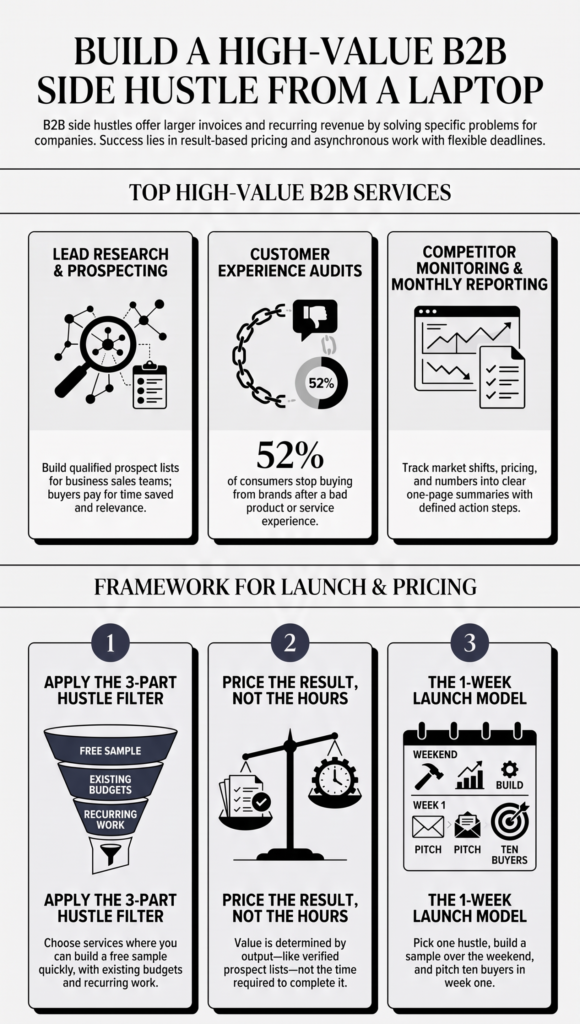
How to pick one. Use a simple filter. Choose the hustle where you can build a free sample this weekend, where the buyer already has a budget and where the work repeats monthly. Lead research, reporting and competitor monitoring tend to pass all three.
How to fit it around a job. Choose work with deadlines measured in days, not hours. Research, reporting and audits can be done at 6am or 9pm. Live inbox coverage can’t. Tell clients when you work and when you reply. Most business buyers care about reliability more than speed.
What to charge. Price the result, not the hours. A verified list of 100 prospects has a value to a sales team that doesn’t depend on whether it took you five hours or fifteen. Start with a small pilot at a proper rate, then offer the monthly version.
What to avoid. Don’t run two of these at once. Don’t start with outreach services if you haven’t read the rules for the channel you’ll use. Don’t promise sales, because you don’t control the client’s closing. Promise what you control: lists delivered, messages sent, meetings booked, reports on time.
Pick one. Build the sample. Send it to ten people. That’s a weekend and a week of follow-up, and at the end you’ll know if there’s a buyer.
Sources
1. LinkedIn Help, “Prohibited software and extensions.” https://www.linkedin.com/help/linkedin/answer/a1341387
2. U.S. Federal Trade Commission, “CAN-SPAM Act: A Compliance Guide for Business.” https://www.ftc.gov/business-guidance/resources/can-spam-act-compliance-guide-business
3. Australian Communications and Media Authority, “Avoid sending spam.” https://acma.gov.au/node/73
4. PwC, “2025 Customer Experience Survey.” https://www.pwc.com/us/en/services/consulting/commercial-excellence/library/2025-customer-experience-survey.html